You’ve Been Asking AI to Do the One Thing It Was Never Going to Be Good At
If you’ve ever tried to do something real with an AI system and wound up wanting to throw your laptop into the ocean, this is for you.
I don’t mean “summarize this email” or “write a LinkedIn post.” I mean the kind of thing people actually care about: real workflows, real products, real stakes. You start optimistic, the demo looks incredible, the first few runs are promising… and then something quietly goes sideways. The outputs get flaky. The agent “forgets” something critical. It hallucinates with total confidence. The more you push it toward autonomy, the worse it gets.
You tweak prompts. You add more instructions. You move to a newer model. You switch vendors. You bolt on tools. You watch the cost and complexity explode while reliability somehow drops.
I’ve been stuck in that loop longer than is reasonable. The only reason I’m not still there is that I have a pathological inability to stop asking “why” when something keeps failing the same way. This is the answer I eventually backed into.
And once you see it, you can’t unsee it.
What We’re Each Actually Good At
Let’s start with the uncomfortable truth nobody really says out loud.
These frontier models are insanely good at some things and structurally bad at others. Humans are the mirror image. The problem isn’t that either is “weak.” It’s that we keep asking each to do the other’s job.
At a very high level:
AI is superhuman at:
Spotting patterns across ridiculous amounts of text, code, data
Filling in missing pieces in familiar patterns
Repeating well-defined operations at scale without getting bored
AI is structurally weak at:
Carrying the meaning of relationships intact when context shifts
Knowing which details actually matter in a new situation
Deciding where one task really ends and the next really begins
Humans are superhuman at:
Understanding what matters and why in a messy, novel situation
Preserving the relationships between things as we move across contexts
Defining boundaries: “this is the same thing,” “this is different,” “this doesn’t belong here”
Humans are weak at:
Sifting millions of weak signals and remembering every relevant detail
Doing repetitive, precise work without drifting
Staying unbiased and consistent over long stretches of time
Stated bluntly: AI is pattern at scale. Humans are meaning across contexts.
That’s the whole game.
You don’t need to know any math or theory to get this. Just feel into your own experience. When an AI nails something, it’s usually because it found the right pattern and ran it cleanly. When it fails in the most painful way, it’s because the pattern was right and the meaning was wrong.
You’ve seen this.
How We’re Actually Using AI
(And Why It Was Always Dumb)
Now take that simple inventory and hold it next to how the industry has decided we should use AI.
“Autonomous agents” that make long chains of decisions by themselves
“AI employees” that own end-to-end workflows
Long prompt scripts that try to cover every scenario and role in one giant shot
Massive “intelligent” pipelines where one model hands off to another, then another
Look at that through the lens we just set.
We’re taking the thing that’s good at patterns inside a well-defined task and asking it to manage the boundaries between tasks, the meaning of decisions, and the carry-over of context from step to step.
Those boundaries and that meaning are exactly where the model is weakest.
Then we’re surprised when the failures show up precisely at the boundaries: the off-by-one assumption, the lost requirement, the subtle constraint that was clear to you but never made it all the way through the chain.
This isn’t “AI isn’t smart enough yet.” It’s the architecture asking it to do the wrong job.
We keep shoving “own the whole thing for me” onto the column that’s good at pattern completion, not boundary definition. The failures are not surprising; they’re guaranteed.
Ignoring the Crash Data and Hitting the Gas
At this point, you’d think the sensible move would be:
“Okay, so we should keep the AI on the parts where pattern-at-scale is a superpower, and keep humans on the parts where meaning and boundaries matter most.”
Instead, we did the opposite.
We saw agents failing in long chains. We watched enterprises report that most AI pilots never make it to reliable production. We lived through hallucinations, security incidents, bad decisions justified with confident nonsense.
And the collective answer was: what if we just had… more of it?
More tasks delegated end-to-end
More complexity in the agent logic
More attempts to have AI “plan” and “reflect” and “self-correct” over longer and longer horizons
We took the weak spot — preserving meaning across steps — and decided the fix was more steps.
It’s honestly impressive how consistent we’ve been in doing the exact wrong thing.
“Let’s Have Them Check Each Other’s Work”
Then came the next brilliant idea.
“What if we had multiple AIs, each with a role, and they could talk to each other and keep each other honest?”
On paper, that sounds great. Humans do this. We specialize, we coordinate, we cross-check. Teams work better than lone wolves.
But remember the actual shape of what we’re working with.
Each model is already running an internal conversation with itself every time it generates text — it’s not a single step, it’s a rolling dialogue under the hood. When you connect multiple “agents,” you’re not connecting neat little functions. You’re hooking ongoing, fuzzy internal conversations up to each other and letting them inject into each other’s heads.
The hope is: “Now we have independent checks and balances.”
The reality is: they share the same strengths and the same blind spots. Their errors aren’t independent. They’re correlated.
So when Agent A’s internal narrative drifts a bit off, that drift gets passed to Agent B as truth. B builds on it, adds its own drift, and passes that to Agent C. Every handoff is another opportunity to warp meaning and lose the thread.
You didn’t build a safety net. You built a confidence amplifier for errors you can’t see.
The math: chain enough “pretty good but not perfect” steps together and you’re not at “pretty good.” You’re at confidently wrong in ways no individual step ever obviously shows. The system looks like it’s working right up until it very much isn’t.
And again: we’re surprised.
AND THEN WE GAVE THEM TOOLS
Just when the pattern should have been obvious, we got excited and added one more twist.
“You know what will fix this? Tools. Let’s plug them into everything.”
Databases. Browsers. Code execution. Repo access. Internal APIs. Email. Calendars. You name it, someone gave an agent a tool for it.
Tools can be good. The problem isn’t the tools themselves. It’s what happens when you hand them to a system that’s already struggling to maintain coherent context across steps.
Remember where the model is weak: maintaining the right meaning, at the right level of abstraction, across changing context. Now imagine the runtime:
An agent is already juggling the user’s request, its own internal reasoning, and whatever prior steps it took
We hand it a tool that returns a huge, authoritative blob of text or data
That blob lands in the model’s context and quietly becomes the most salient thing in the room
What happens? The model starts treating the tool output as the primary reality. The instructions and intent that were supposed to be governing its behavior get buried under whatever the last tool just dumped into its head.
From the outside, it looks like capability. Internally, the agent’s sense of what matters just got hijacked — and it has no idea.
We gave the thing that’s bad at boundaries a room full of doors and said “have fun.”
The Part That Should Make You Actually Angry
Here’s the punchline. None of this was necessary.
Let’s do a quick thought experiment. Say you want to verify the citations in a research paper. Sounds like a perfect AI task, right? Lots of text, lots of pattern matching, tedious for humans. Let’s actually break it down:
What needs to happen:
Extract every reference from the bibliography. Normalize the formatting. Flag anything malformed or missing.
Resolve each citation — hit the DOI registries, check retraction databases, confirm the paper actually exists and the metadata is right.
Go back to the body of the paper. Find where each citation is invoked. Extract the exact claim being made — what is this citation supposedly proving?
Read the actual source. Find the relevant section. Does it say what the citing paper claims it says? Or does it say something narrower, something hedged, something that technically doesn’t contradict the claim but was stripped of all its caveats?
Synthesize: clean, cherry-picked, misrepresented, overclaimed, or fabricated?
Decide what it means for the paper’s validity and what you’re going to do about it.
Now draw the lines honestly.
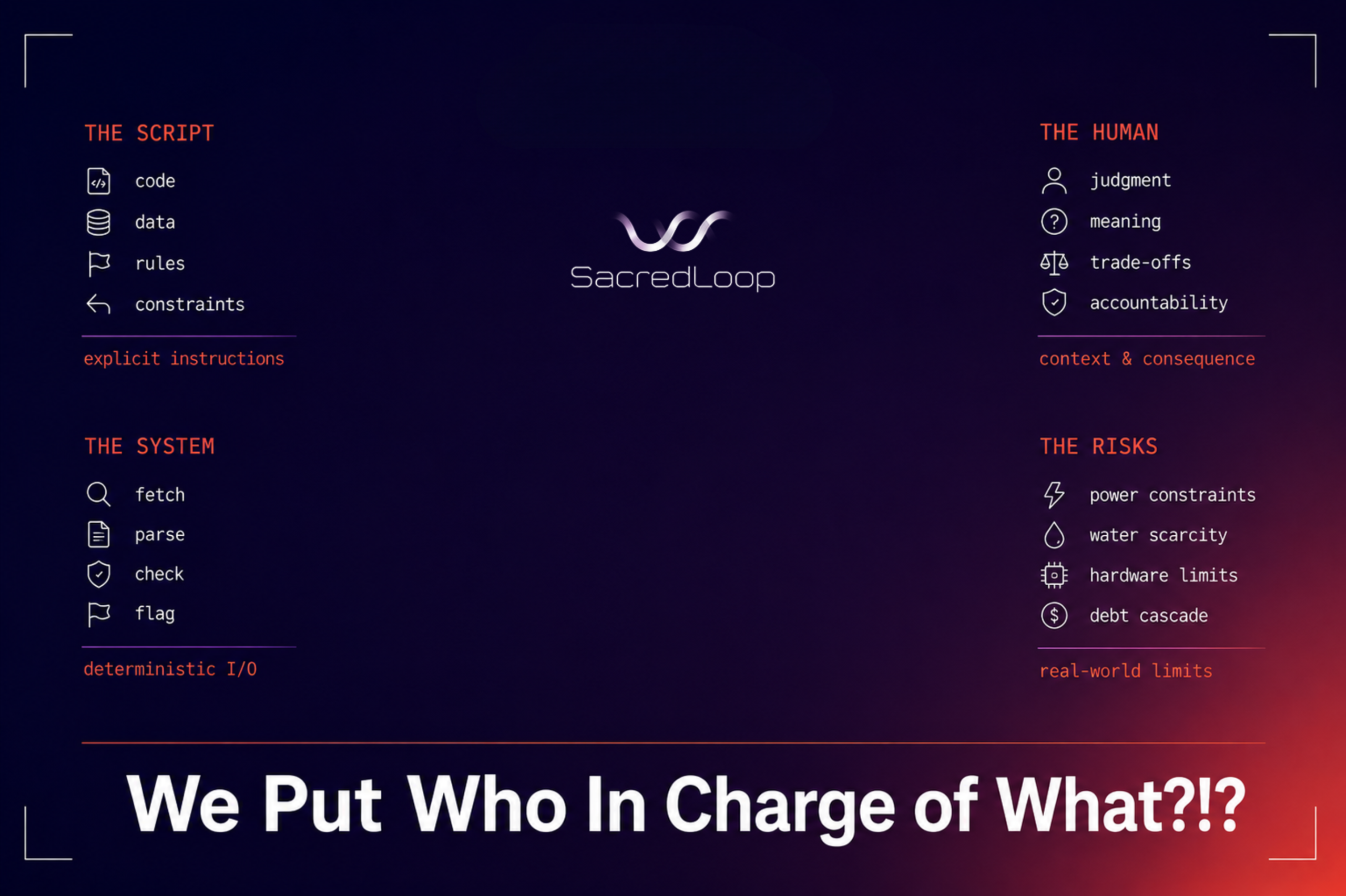
Steps 1 and 2? Pure deterministic input/output. Fetch, parse, resolve, compare, flag. A script does this. Not an AI — a script. Fifty lines of code. Runs in seconds. Never hallucinates a DOI. Never gets tired and skips one.
Steps 3, 4, and 5? Semantic reasoning over text at scale. Locate the claim, read the source, characterize the mismatch. This is exactly what AI is good at — pattern recognition with comprehension, across the full reference list, in one pass. Not a human spending hours hunting through PDFs. Not a script that can’t read. The AI.
Step 6? Consequential judgment with real stakes in a context only you fully hold. You. Thirty minutes. The decisions that actually matter.
You end up with: a complete, reliable citation audit where the script handles the mechanical retrieval, the AI handles the semantic heavy lifting, and you spend thirty minutes making decisions instead of days doing everything manually.
Now compare that to what most “AI-powered” citation tools actually do: throw everything at the model and hope it figures out which parts require deterministic lookup and which require judgment. It doesn’t. It can’t. It blends them into a confident soup that’s unreliable at exactly the steps where reliability is most critical.
The three layers aren’t complicated:
Script: deterministic I/O. Same input, same output. Every time.
AI: semantic reasoning inside a well-defined scope.
Human: consequential decisions that require meaning, context, and stakes you actually hold.
The orchestration between them — which layer handles which step, in what order — is a macro. Not an AI. Not a complex agent. A simple, callable, human-designed rule: given this input, run this script, pass the output here, invoke the model for this part, surface this to the human.
That’s the whole architecture.
That’s it. Not a platform. Not an agent framework. Not a $50M infrastructure buildout.
A script that does the dumb mechanical work it was always supposed to do. An AI that handles the semantic heavy lifting inside a clearly marked box. A human sitting at the decisions that actually have stakes. And a macro that knows which is which.
The reason this feels radical is that we spent two years being told the AI should own the whole thing. It shouldn’t. It was never going to. And the sooner you stop asking it to, the sooner it starts being genuinely useful.
Start with one operation you want to be reliable. Define its edges. Build the box. That’s the on-ramp.
Everything else follows from there.
I’m Jason Hubbard, CEO and founder of Sacred Loop and an independent AI architect and researcher. I build systems at the edge of what current AI can do — and I document the gap between what the industry claims it built and what it actually built.
I write about AI infrastructure, system design, and technical reality not to flatter the engineers or comfort the investors, but because the receipts are public and nobody’s bothering to add them up.
If this hit a nerve, subscribe and share it with someone who still thinks the efficiency problem is someone else’s worry.
Follow me on X: @SacredLoopJason
Subscribe on Substack
This research was conducted independently through Sacred Loop. No compensation was received from any hyperscaler, infrastructure vendor, or financial institution in connection with this work.